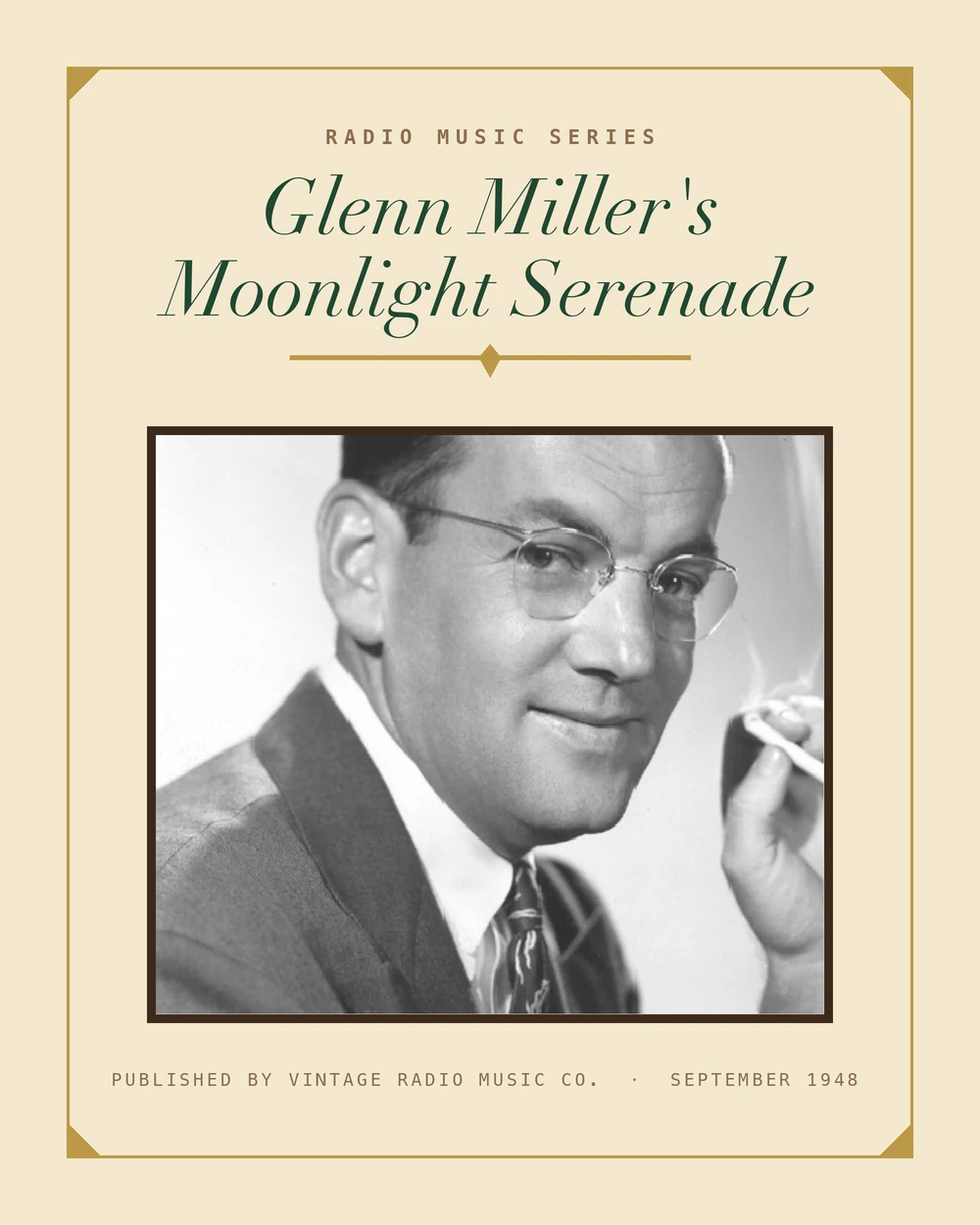
Glenn Miller's Moonlight Serenade
How It Got on the Air
Glenn Miller didn't stumble into his CBS radio series — he inherited it. Paul Whiteman had been hosting a half-hour Chesterfield program on CBS, and when Whiteman decided to step back, he recommended Miller as his replacement. Liggett & Myers, the makers of Chesterfield cigarettes, came on as sponsor, and the deal gave Miller and his orchestra a reliable weekly income that touring alone couldn't guarantee. The series premiered on CBS on December 27, 1939, initially as a 30-minute program.
Chesterfield had one concern going in: they weren't entirely sure Miller could hold an audience on his own. To hedge that bet, they brought in the Andrews Sisters as co-stars for the first 13 weeks — from the December 1939 premiere through roughly March 1940. Beginning January 2, 1940, the format was trimmed to 15 minutes and settled into a Tuesday-Wednesday-Thursday slot at 10:00 p.m. on CBS. Once the Andrews Sisters' initial run wrapped, Miller carried the series himself through September 1942.
Paul Douglas, a CBS announcer who would later find success on Broadway and in Hollywood films, served as host and commercial pitchman throughout the entire 1939–1942 run. Douglas was a consistent on-air presence, delivering the Chesterfield pitches with the easy authority of a seasoned broadcaster. His voice was as much a fixture of the show as Miller's trombone.
The Theme and Its History
"Moonlight Serenade" was already Miller's radio signature before it had that name. He composed the melody in 1935 — it went by "Miller's Tune" and later "Now I Lay Me Down to Weep" — as an exercise while studying the Schillinger System under Joseph Schillinger, a mathematical approach to composition. By 1938, Miller was using it to open his radio broadcasts. Lyrics came later, eventually settled by Mitchell Parish after two earlier sets had been written by Eddie Heyman and George Simon.
The song was formally recorded on April 4, 1939, at RCA Victor Studios and pressed on RCA Bluebird as the B-side to "Sunrise Serenade." It reached number three on the Billboard charts, spent fifteen weeks there, and finished as the fifth-most-popular hit of 1939 in Billboard's year-end tally. The recording was inducted into the Grammy Hall of Fame in 1991.
What gave the recording its sound was the arrangement: clarinet and tenor saxophone carrying the lead over the saxophone section, a combination that became the defining feature of the Miller style. Wilbur Schwartz played the clarinet lead on that original 1939 session. "Moonlight Serenade" is a swing ballad in 4/4 time — not a waltz, despite how gently it moves — and that clarinet-led reed voicing set it apart from everything else on the radio dial.
The ASCAP Ban and the Substitute Theme
In January 1941, a licensing dispute between ASCAP and the radio networks put a wide range of published music off-limits for broadcast. "Moonlight Serenade" was an ASCAP composition, which meant Miller couldn't use it on the air from January 1 through October 31, 1941. He needed a replacement theme, and he found one in "Slumber Song," a BMI-published tune written by his pianist Chummy MacGregor and Saul Tepper. During the ban, "Slumber Song" served as both the sign-on and closing theme for the Chesterfield broadcasts. When the ban ended and "Moonlight Serenade" returned as the opening theme, "Slumber Song" stayed on as the closing — a role it held through the rest of the run.
That arrangement is why "Slumber Song" turns up as the opening number on at least one surviving episode in the catalog. The episode openings sketch the series across its different phases: "Polka Dots and Moonbeams," "At Last," "Moonlight Cocktail," "Five O'Clock Whistle," "People Like You and Me," "Sweet Eloise" — a cross-section of Miller's repertoire at its peak commercial moment.
A Gold Record, Live on the Air
On February 10, 1942, something unusual happened during a Chesterfield Moonlight Serenade broadcast: RCA Victor presented Miller with the first gold record ever made, on the air, in front of the CBS audience. The record was for "Chattanooga Choo Choo," which had sold over 1.2 million copies, and announcer Paul Douglas was present for the moment. The first gold record presentation in music industry history happened not at a formal ceremony but during a routine Tuesday-Wednesday-Thursday quarter-hour. That it happened on this show says something about how central the Chesterfield broadcasts had become to Miller's public presence.
Beyond CBS, Miller was on the air even more often. In 1940, NBC sustaining (non-commercial) broadcasts brought his orchestra into American homes six or seven days a week in total. In 1941, he launched a separate NBC program, "Glenn Miller Sunset Serenade," running parallel to the Chesterfield series on CBS.
The Final Broadcast and What Came After
Miller's last Chesterfield Moonlight Serenade aired on September 24, 1942 — the date that closes out the episode catalog. During that final program, Miller announced that Harry James would be taking over the Chesterfield slot. He then enlisted in the U.S. Army Air Forces. By December 15, 1944, holding the rank of Major, he was reported missing over the English Channel on a single-engine flight from England to France. He was never found.
In the early 1950s, the Glenn Miller Estate used private recordings of the Chesterfield Moonlight Serenade programs to produce a syndicated radio series under the title "Glenn Miller's Moonlight Serenade." Those discs were later copied to tape by RCA for record releases. The 15 episodes in the current catalog date from the January 1940 through September 1942 CBS run — a window into a band at the height of its radio popularity, before the war changed everything.
The "Moonlight Serenade" recording has continued to circulate well beyond radio. It was released as U.S. Army V-Disc No. 39A in November 1943 by the War Department for distribution to military personnel — Miller was already in uniform by then — and it has turned up on theatrical soundtracks including The Aviator (2004) and Rumor Has It… (2005).